XtraMath Student Login: The Complete 2026 Guide for Students, Parents & Teachers
If you are searching for the XtraMath student login, you are one click away from a tiny, daily math habit that has helped millions of children master addition, subtraction, multiplication, and division facts. Before we walk through every sign-in method, common errors, and pro tips, try the free math fluency tool below — it mimics how an XtraMath session feels, so students can warm up right now without an account.
⚡ Quick Math Fluency Trainer Free • No login
That little drill is built around the same idea XtraMath uses every day: short, timed, focused practice that turns slow calculation into fast recall. Now let’s get you logged in.
Figure 1 — XtraMath supports three account types, each with its own sign-in page.
What Is XtraMath and Why Does the Login Matter?
Xtra math is a free, web-based program that helps students build math fact fluency — the ability to recall basic arithmetic (like 7 × 8 or 12 − 5) automatically, without finger-counting or hesitation. A daily session takes only about 10 minutes, and the platform uses adaptive logic and spaced repetition so each child practices the exact facts they have not yet mastered.
The reason the XtraMath student login matters is simple: every student’s progress, PIN, placement quiz results, and program (addition, subtraction, multiplication, or division) are tied to their personal account. Sign in to the wrong account — even for one session — and the adaptive engine starts learning the wrong child. That is why understanding the right login method for your situation is worth a few minutes of reading.
Before You Sign In: What You Need to Know
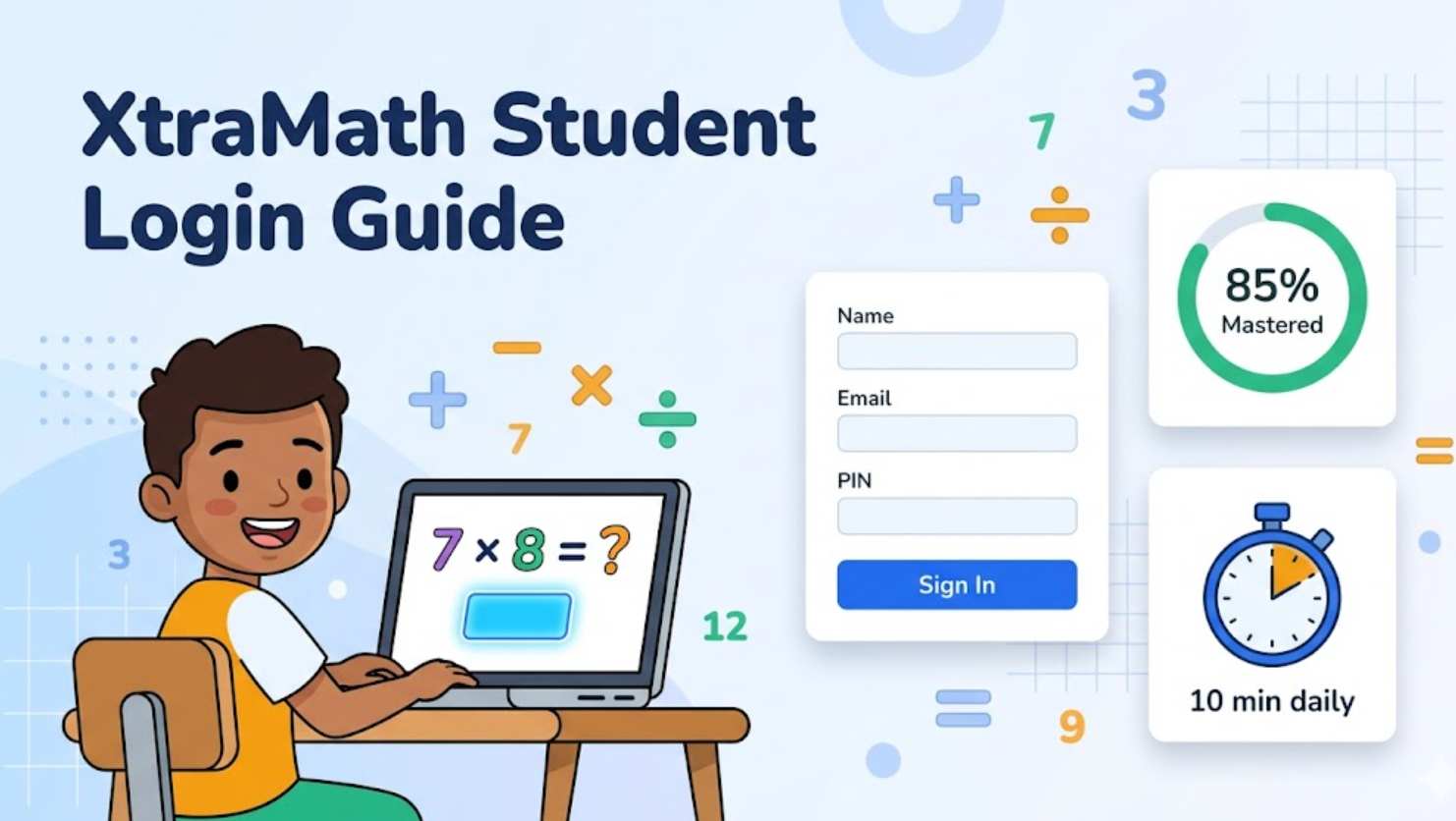
Unlike most apps, students cannot create their own XtraMath account. The account must first be set up by a teacher or by a parent through a family account. Once that happens, the student needs exactly three pieces of information to sign in on the standard student page:
- Their name — entered exactly how the teacher or parent typed it (sometimes just a first name, sometimes a first name plus last initial, occasionally a nickname).
- An email address — usually the teacher’s school email, or a parent’s email if the account was set up at home. XtraMath does not store student email addresses; the adult’s email is what identifies the right child among thousands of others with the same first name.
- A 4-digit PIN — randomly assigned when the account is created. Teachers can print a class PIN list; parents can find each child’s PIN at the top of their student report.
💡 Quick Tip for Parents
If your child uses XtraMath both at school and at home, they can sign in with either the teacher’s email or your email — both will land them in the same account, as long as the teacher has sent home a family flyer and you’ve enrolled your child.
XtraMath Student Login: Step-by-Step Instructions
The fastest, most reliable way to sign in is the official XtraMath login page. Here is exactly what to do.
Method 1 — Sign In With Name, Email & PIN (Most Common)
- Open a web browser and go to the XtraMath sign in page, then click “Sign In” in the top corner.
- Choose the Student Sign In option. Do not click the Parent/Teacher button — it asks for a 6-character password and will reject the 4-digit PIN.
- Type the student’s first name exactly as the teacher or parent entered it. Spelling and capitalization should match.
- Enter the teacher’s email address (at school) or the parent’s email address (at home).
- Type the student’s 4-digit PIN.
- Click Sign In. The daily session loads automatically.
- (Optional, private device only) Check the Remember me box so the next sign-in is one tap.
⚠ Never use “Remember me” on a shared device
Library computers, school iPads, and shared family tablets all keep that login alive in the browser. The next person to open XtraMath will land directly in your child’s account — including any mischievous younger siblings.
Method 2 — Sign In With Google
Schools that use Google Workspace can let students sign in with one click. The first time a student presses the Sign in with Google button, they still need to type their XtraMath name, email and PIN once — this links their Google account to the right XtraMath account. After that, future sign-ins are automatic.
Google sign-in works best for students on personal Chromebooks. For shared classroom devices, it can backfire — a student might accidentally sign in under the wrong Google profile and land in someone else’s XtraMath account. Teachers using shared devices usually disable this option.
Method 3 — Sign In Through Clever or ClassLink
If your school uses a rostering platform like Clever or ClassLink, the easiest path is to start there. Open the Clever or ClassLink portal first, find the XtraMath icon on the dashboard, and click it. The single sign-on flow drops the student directly into their XtraMath session, with no name, email, or PIN to remember.
Two things to note: the XtraMath icon will only appear on the student’s Clever dashboard if the teacher has also added XtraMath to their own Clever dashboard, and some schools issue physical “Clever Badges.” Younger students can hold the badge in front of the device camera, and the system signs them in once the green checkmark appears.
Method 4 — Classroom Sign-In Page (Shared Devices)
For shared classroom iPads or computers where many students rotate through the same device, teachers can use the Classroom Sign In page. The teacher signs in once, “authorizes” the device, and from then on students just tap their name from a list and enter their PIN. This is dramatically faster than typing the teacher email forty times a day, and it dramatically reduces sign-in errors with younger students.
Figure 2 — Picking the right sign-in method saves minutes of class time every day.
XtraMath Student Login on Mobile Apps
XtraMath has free official apps for iOS, Android, and Amazon Fire tablets. The sign-in flow is identical to the website: choose Student Sign In, enter name, the adult’s email, and the 4-digit PIN. The mobile app also stores the connection after the first sign-in so younger students can return to their account with a single tap.
One important note for parents: students cannot create accounts inside the app any more than they can on the website. You’ll still need to set up the family account on a desktop or laptop browser first, then hand the tablet to your child for daily practice.
Devices and Browsers That Work Best
XtraMath is intentionally lightweight, so almost any modern device works. It runs smoothly on Chromebooks, Windows and Mac laptops, iPads, Android tablets, and even older school desktops. The web version supports the latest two versions of Chrome, Safari, Firefox, and Edge. If a session feels laggy, a hard refresh (Ctrl + Shift + R on Windows, ⌘ + Shift + R on Mac) usually fixes it instantly.
Common XtraMath Student Login Problems (and Quick Fixes)
Most sign-in failures fall into one of five categories. Here’s how to diagnose and resolve each one in under a minute.
| Error Message | What It Means | How to Fix It |
|---|---|---|
| “Name not found” | The name doesn’t match what the teacher or parent entered. | Check spelling and capitalization. Try with and without the last initial. Ask the adult what was typed. |
| “PIN does not match” | Wrong 4-digit PIN, or you’re typing the PIN of a sibling/classmate. | Parents: sign in to your account, open the student report, and the PIN appears at the top. Teachers: print the class PIN list. |
| “Email address not found” | The email isn’t connected to any XtraMath account. | Double-check spelling. Make sure you’re using the teacher’s email if at school, or the parent’s email if at home. |
| “Passwords must be at least 6 characters” | You’re on the Parent/Teacher sign-in page by mistake. | Click “Student Sign In” instead — it asks for a 4-digit PIN, not a password. |
| “You’re done” | The student has finished the assigned program. | Celebrate! Ask the teacher to assign the next program (e.g., move from addition to subtraction). |
Forgot Your XtraMath PIN? Here’s How to Recover It
Students do not have passwords, so there is no traditional “reset” button. Instead, the PIN lives in two places: on the student report inside the teacher’s or parent’s account, and in the system’s email-recovery flow. To recover it:
- Parents: Sign in to your family account on the XtraMath sign in page, click on your child’s name, and look at the top of the student report. The PIN is displayed there. You can also visit the Student Sign In page, click “Forgot your PIN?”, and the system will email PINs for all children linked to your account.
- Teachers: Sign in, open your class report, and click the “Print PIN list” link in the left sidebar. Many teachers laminate this list and keep it near the classroom computers.
- Students: Ask your teacher or parent. PINs cannot be recovered by students directly — this is a deliberate privacy protection.
Locked Out, Stuck, or Frozen?
If the page won’t load, the mobile app freezes, or you see broken images, try these in order:
- Hard refresh the page (Ctrl + Shift + R on Windows / ⌘ + Shift + R on Mac).
- Close and reopen the app from the device’s app carousel.
- Try a different browser or device — sometimes one device has cached an old version.
- Check your school’s firewall — some districts block third-party sites by mistake. The teacher or parent can request whitelisting from IT.
- Check your internet connection by loading another website. A flaky connection is the single most common cause of “stuck” sessions.
📌 Pro Tip: Use a Different Device to Diagnose
If sign-in fails repeatedly, try the same credentials on a phone, then a laptop. If one works and the other doesn’t, the problem is the device — not the password. If both fail, the credentials are wrong.
How a Daily XtraMath Session Actually Works
Once a student signs in, the platform does the heavy lifting. New students start with a quick placement quiz that measures which facts they already know fluently. The system then assigns a personalized practice plan focused only on the facts that are not yet automatic.
Each daily session is built around a spaced-repetition engine: facts the student answers quickly and correctly are revisited less often, while shakier facts come back more frequently until they’re solid. A short timer encourages real recall instead of slow counting on fingers — the whole point is to move math facts from working memory into long-term memory, where they become effortless.
What Students Should Expect in Their First Week
The first few sessions can feel hard, because the system is deliberately probing the edges of what the student knows. By week two, most kids notice they’re answering faster, and the “race the teacher” mini-games become genuinely fun. Daily practice — even just 10 minutes — beats long, infrequent sessions every time.
For Parents: Setting Up a Family Account So Your Child Can Sign In
If your child’s school doesn’t use XtraMath but you want to use it at home, you can create a free family account in about three minutes. Visit the XtraMath homepage, click Sign Up, and choose the parent option. You’ll need your own email address and a password (at least 6 characters). After verifying your email, click Add Child, type your child’s name, select the grade level, and the system auto-generates a 4-digit PIN. Write the PIN down — that’s what your child will use to sign in.
If your child already uses XtraMath at school, ask the teacher for a “family flyer” with an enrollment code. Entering that code on the Sign Up page connects your home account to your child’s existing school account, so progress made at school and progress made at home both feed into the same report. No duplicate accounts, no fragmented progress.
For Teachers: Helping Students Sign In Faster
The single biggest time-saver in a classroom is the Classroom Sign In page. Sign in once at the start of the year on each shared device, authorize it, and from then on students tap their name from a list and enter their PIN. No more typing your school email forty times a day. For a deeper walkthrough of classroom features, reporting, and bulk account creation, see our complete XtraMath teacher guide.
Three other tips that compound over a school year:
- Print and laminate the class PIN list. Keep it near the device station so a forgotten PIN never derails a session.
- Send home family flyers early — when parents enroll, they can use their own email, taking pressure off you for password reminders.
- Disable Google sign-in on shared devices to prevent students from accidentally signing into a classmate’s account.
Privacy, Safety & Compliance: Is XtraMath Safe to Sign Into?
XtraMath was built with privacy as a core requirement. The platform complies with COPPA (the U.S. Children’s Online Privacy Protection Act), FERPA (the Family Educational Rights and Privacy Act), and the GDPR in Europe. The most important consequence for families: XtraMath does not collect student email addresses, does not show advertisements to students, and does not sell or share student data.
That said, a few common-sense habits keep accounts secure:
- Use a unique password (at least 8 characters with letters, numbers, and a symbol) for the parent or teacher account. Don’t reuse a password from another site.
- Never use “Remember me” on shared, public, or school-loaner devices.
- Don’t share PINs in group chats or post them publicly — they’re the equivalent of a student password.
- Sign out at the end of every session on a borrowed device.
Free vs Premium: What Does the Student Login Unlock?
The good news: every student account gets full access to the core XtraMath practice engine for free. The free tier includes daily adaptive sessions, all four operations (addition, subtraction, multiplication, division), the placement quiz, progress reports for adults, and the mobile apps.
XtraMath also offers a paid Premium tier with extras like additional practice activities, custom session length, customizable answer time, and more detailed analytics for teachers. The free version is more than enough for the vast majority of families and classrooms — Premium is mostly worthwhile for schools that want deeper data or teachers running large multi-grade interventions.
Figure 3 — A daily XtraMath session has a predictable rhythm that helps students settle in fast.
XtraMath Login Best Practices: 8 Things Experienced Teachers Recommend
- Sign in at the same time every day. A consistent routine — right after lunch, or first thing after homework — is what builds the habit faster than anything else.
- Keep sessions short. 10 minutes is the magic number. Pushing kids past 15 minutes leads to fatigue and wrong answers, which actually teaches the wrong fact.
- Never let a student sign into the wrong account. Even one session in a sibling’s or classmate’s account corrupts the adaptive engine for both kids.
- Use the same device when possible. Browsers remember your network, which speeds future sign-ins.
- Celebrate small wins. The “Race the Teacher” activity is a confidence booster — high-five your child after a strong session.
- Don’t help with answers. The whole point is to expose what the child doesn’t know yet so the engine can target it.
- Review the weekly report together. The student report shows green/yellow/red squares for each day. Make it a Sunday-night ritual.
- Switch programs when one is done. Many families forget that after addition is mastered, the teacher or parent has to manually assign subtraction next.
XtraMath vs Other Math Fluency Apps
Parents often ask how XtraMath compares to apps like Prodigy, Reflex Math, or Khan Academy Kids. Each has a place, but they solve different problems. Prodigy and Khan Academy Kids are gamified, broad math curriculum platforms — great for engagement but slower at building raw fact recall. Reflex Math is closer to XtraMath in philosophy but is paid and skews more game-heavy. XtraMath wins on three dimensions: it’s free, it’s fast (10 minutes versus 20–30 elsewhere), and it’s laser-focused on fact fluency rather than splitting attention across a dozen skills.
The honest summary: if your goal is “my child should not need to count on fingers anymore,” Extra Math is hard to beat. If your goal is “my child should enjoy doing math,” pair XtraMath with something more game-like and you get the best of both.
Frequently Asked Questions About the XtraMath Student Login
Can my child create their own XtraMath account?
What if my child uses XtraMath at school and I also want to use it at home?
Is there an XtraMath app, or only the website?
My child’s Google account got linked to the wrong XtraMath account. How do I fix it?
How do I know my child is on the right account before they start?
Does XtraMath work offline?
How much does the student login cost?
What’s the minimum age for XtraMath?
Why does my child sometimes see “Race the Teacher”?
Final Thoughts: A Tiny Login, A Big Habit
The XtraMath student login is one of those small details that has an outsized effect on whether daily practice actually happens. When the sign-in is fast, the kid sits down. When it’s slow, frustrating, or lands them in the wrong account, the habit collapses within a week. So get the basics right — the correct page, the right email, the 4-digit PIN written somewhere safe, and a clear choice between Method 1 through Method 4 above — and the rest takes care of itself.
Ten minutes a day, the same time, the same place. That’s the entire formula. The login is just the doorway.
Now scroll back up and let your child try the math fluency trainer at the top of this page. It’s a great first taste of what daily Xtramath practice will feel like — and the only “login” required is curiosity.